← Selected work

Robotics · Vision · Research

Autonomous Robotic Surface Inspection

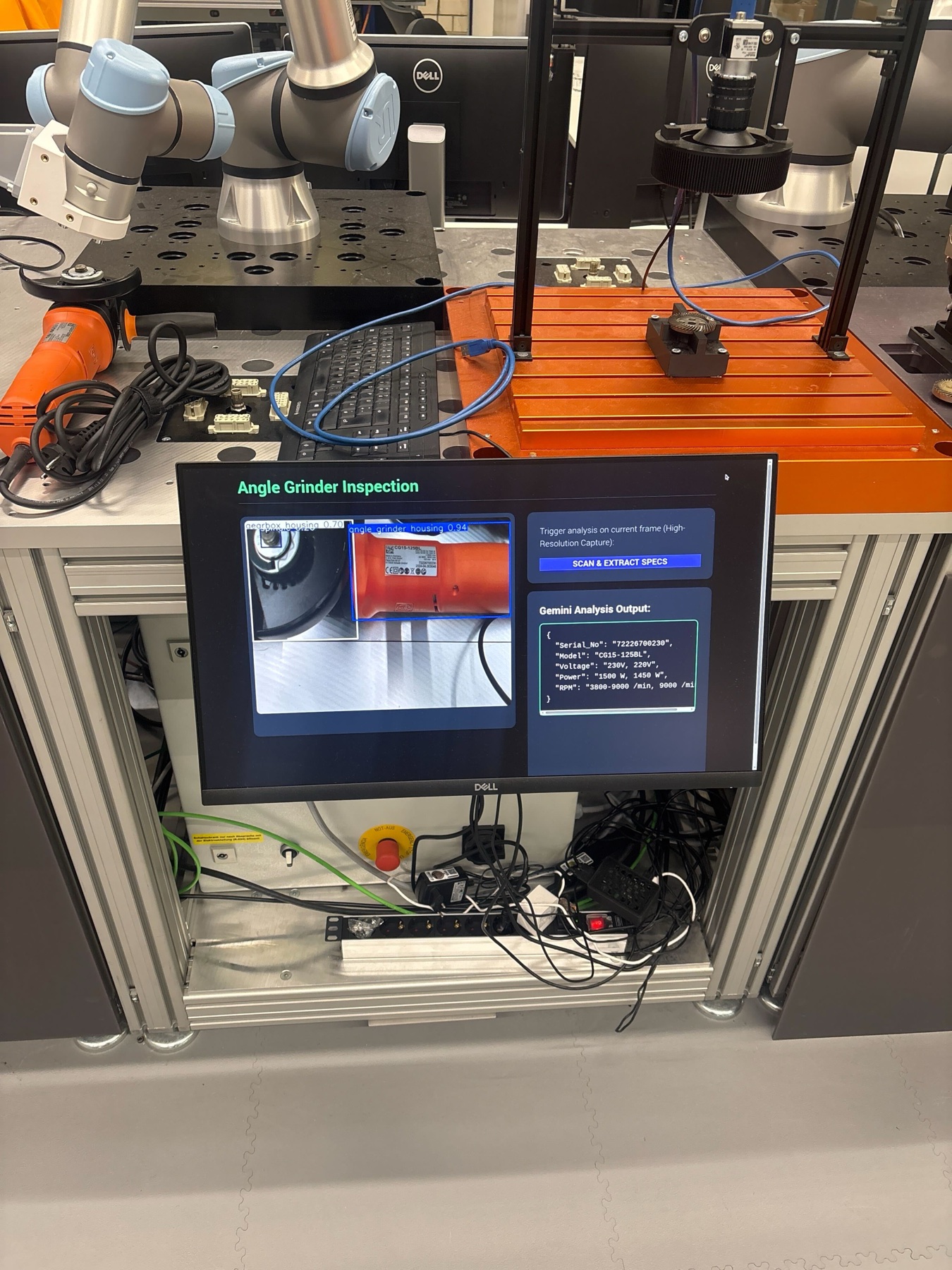
An end-to-end inspection workflow that gave a UR5e the ability to locate a work area, position an RGB-D camera, detect surface defects, and turn visual evidence into physical measurements.

Explore the inspection system on GitHub
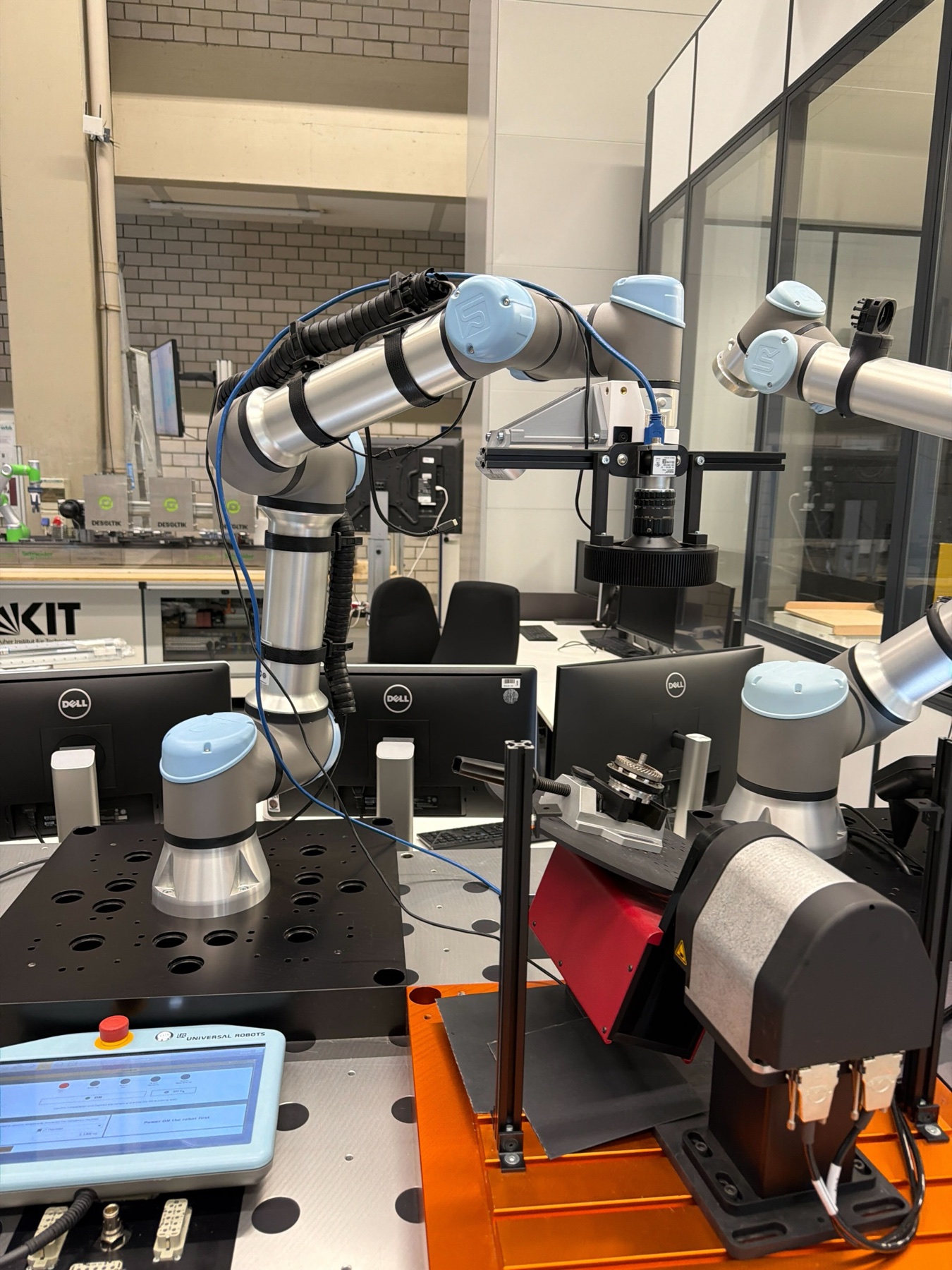
UR collaborative robot and camera inspection rig in the wbk laboratory
UR robot and vision setup in the wbk laboratory.Project archive
StatusCompleted at wbk · Jul 2026
RoleStudent engineer
FocusROS 2 · UR5e · RealSense D435i

The problem

Manual inspection is difficult to scale when surface geometry, viewpoint and defect appearance all vary. The research question was how a robot could combine motion, vision and spatial reasoning into a repeatable inspection process with minimal intervention.

My contribution

  1. 01

    Built the ROS 2 pipeline connecting robot motion, joint-state data, coordinate transforms and RGB-D perception.

  2. 02

    Integrated the end-effector-mounted RealSense camera into a live TF2 tree, allowing observations to be expressed relative to the robot base.

  3. 03

    Applied a custom-trained YOLOv8 model to RGB frames and combined detections with depth data for 3D localisation and dimensional estimation.

  4. 04

    Contributed to the broader autonomous workflow, from workspace localisation to structured inspection output.

Technical challenges

  1. 01

    Keeping camera, tool and base coordinate frames consistent while the sensor moved with the robot.

  2. 02

    Turning noisy depth samples inside a 2D detection region into useful physical estimates.

  3. 03

    Coordinating perception and motion so that each observation had trustworthy spatial context.

What I learned

  1. 01

    A perception result is only as useful as the frame, timestamp and uncertainty attached to it.

  2. 02

    Robotics integration is less about isolated algorithms and more about clear interfaces between sensing, geometry and action.

  3. 03

    Good inspection systems need traceable outputs, not only convincing detections.

Potential next steps

  1. 01

    Improve uncertainty handling for depth-based dimensions.

  2. 02

    Explore viewpoint selection that actively seeks more informative observations.

  3. 03

    Evaluate robustness across a wider range of surfaces, lighting conditions and defect classes.

Tools & concepts

ROS 2UR5eRealSense D435iTF2YOLOv8MoveIt 2

Continue exploring

Formula Student Autonomous Systems