The problem
An autonomous race car must estimate where it is and understand its surroundings quickly enough to act. The challenge is not a single model; it is the relationship between perception, localisation, planning and vehicle dynamics.
SLAM · Localisation · Vehicle Intelligence
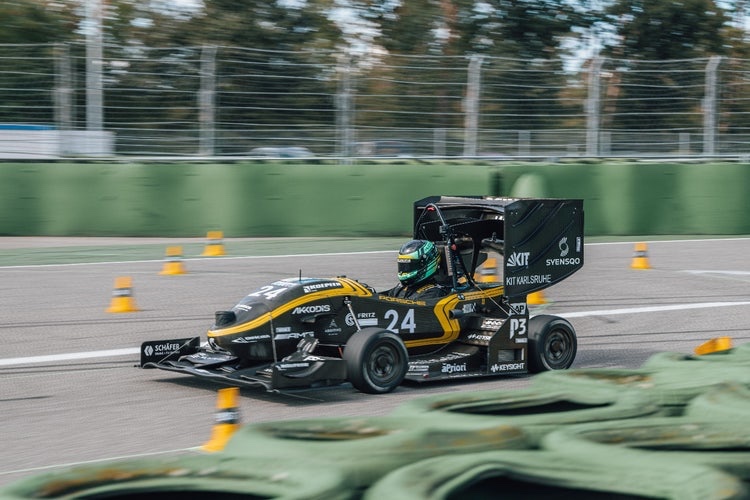
Ongoing work inside KA-RaceIng’s driverless environment, studying how perception, mapping and localisation become dependable vehicle behaviour under real-time constraints.
The problem
An autonomous race car must estimate where it is and understand its surroundings quickly enough to act. The challenge is not a single model; it is the relationship between perception, localisation, planning and vehicle dynamics.
My contribution
Developing my understanding of the existing SLAM-based driving pipeline and the interfaces around it.
Exploring conventional and learned approaches to perception and localisation.
Working within a ROS 2 environment that connects sensor fusion, state estimation, planning and real-time components.
Using simulation and hardware integration as complementary ways to understand system behaviour.
Technical challenges
Balancing model ambition with the predictability required by a real vehicle.
Reasoning about failure modes when perception and localisation influence every downstream decision.
Building intuition across both software behaviour and the physical vehicle.
What I learned
Autonomy is a systems discipline: local accuracy does not guarantee useful global behaviour.
Simulation accelerates iteration, but physical integration exposes the assumptions that matter.
Comparisons between learned and conventional methods need careful, scenario-based evaluation.
Potential next steps
Deepen my contribution as responsibilities develop.
Compare approaches using clear robustness and real-time criteria.
Continue connecting perception outputs to the behaviour of the complete vehicle.
Tools & concepts